
A Complete Guide to Growing Your Business Online
Introduction
In this day and age, a successful business requires a lot more than solid products or services. Another important aspect is that they need to connect with the appropriate audience, establish customer connections, and expand their web marketing. This is where Digital Marketing comes into play.
Digital marketing is a tool for businesses to market their products, engage customers, and compete online. Digital marketing is something that can help you, regardless of whether you are running a small or a large business, to build brand awareness, attract customers, create leads, and drive sales.
Digital marketing is marketing via the Internet. The channels are social media, search engine, websites, email, and mobile applications. Consequently, businesses can reach out to their target audience in a more effective manner.
Knowing about Digital Marketing can create new opportunities for business owners, students, freelance, and marketing professionals. We will be taking a look at the definition of digital marketing, its primary types, and why it is beneficial. We will also be talking about some practical solutions to your business expanding online.
What Is Digital Marketing?
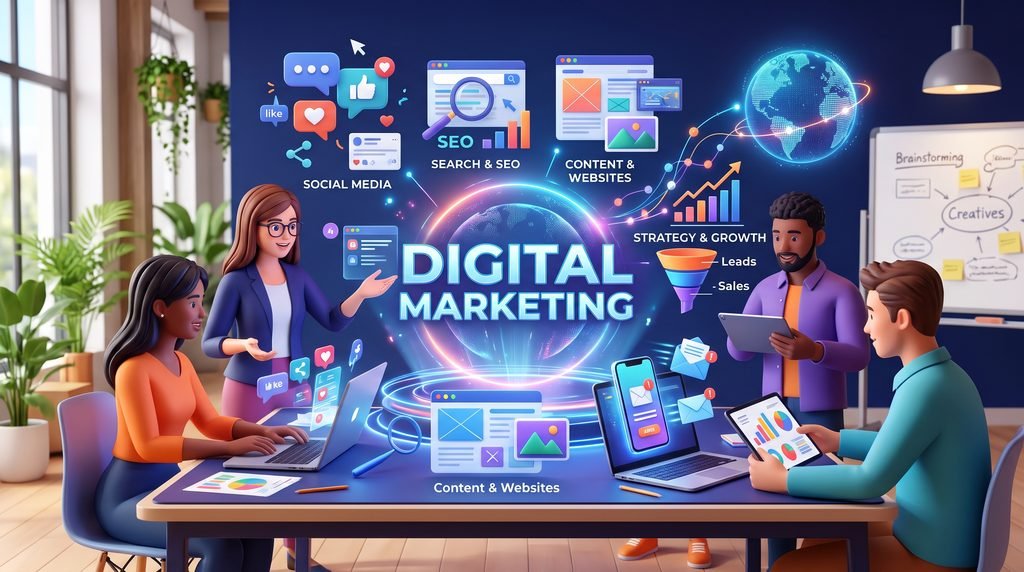
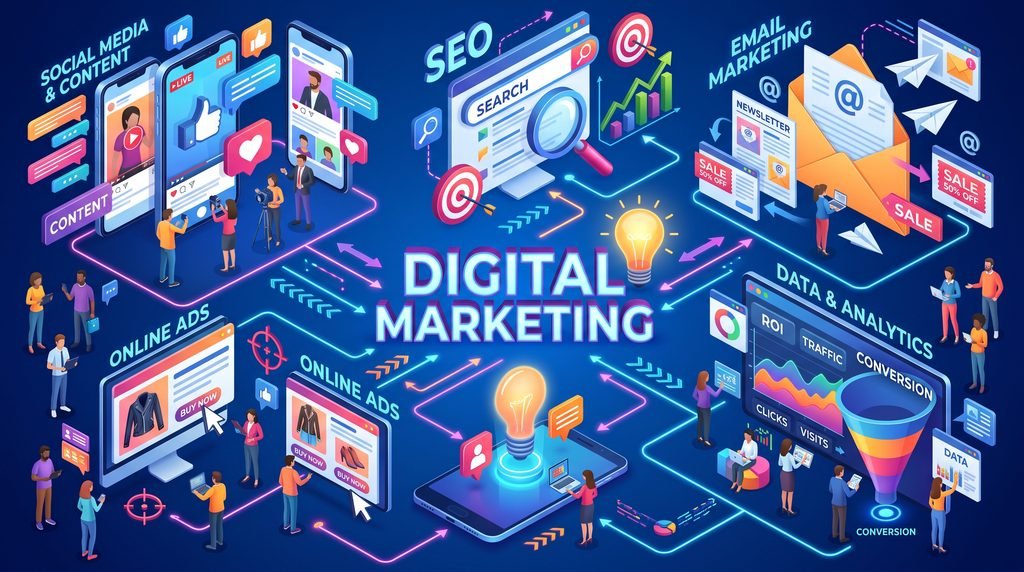
Digital marketing is a method that involves the promotion of goods, services, and brands through digital media. The media may involve search engines, social media, websites, email marketing, ads on the internet, and even platforms for sharing content.
The primary aim of digital marketing is to make sure that there is an interaction between the business and its audience. This process involves the use of creativity, technology, communication, and analysis of data.
For instance, a fashion brand can post pictures of their products on Instagram. The brand can also advertise using Google ads so that people who are looking for clothes will get to see them. Moreover, the fashion brand can send emails to its customers with information regarding new collections and discounts.
Yet another advantage of digital marketing is that results of the campaigns can be measured. Marketers can measure the traffic on their website, how many clicks there were, engagement, leads, and conversions.
Why Is Digital Marketing Important?
There are multiple digital marketing opportunities that are beneficial for companies of any size. Digital marketing enables small businesses to compete online, reach potential clients, and optimize their marketing budgets.
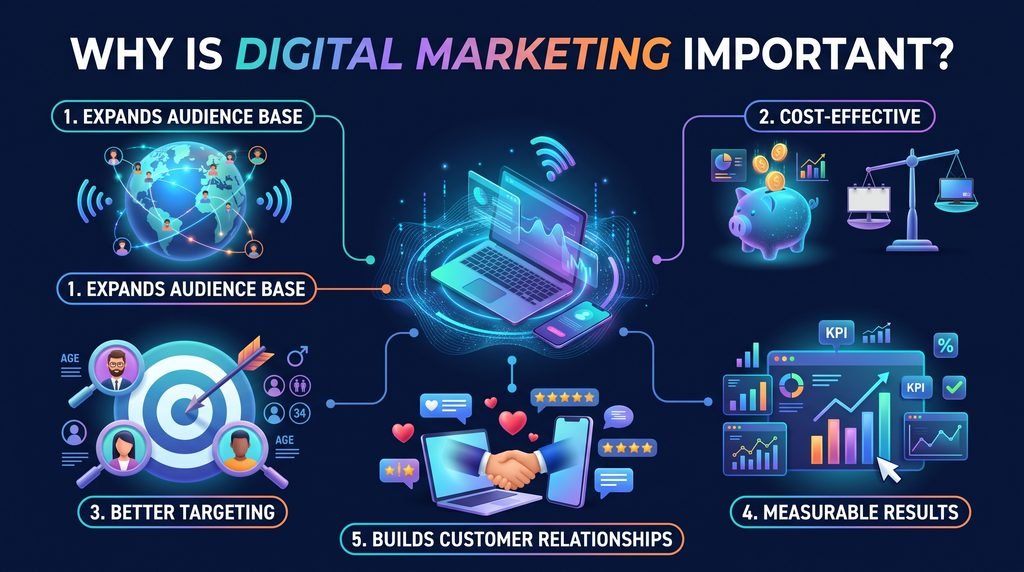
Here are five advantages of digital marketing that can positively impact small companies.
1. Reach Wider Audience
The use of digital platforms allows businesses to communicate with people in various cities, regions, and countries. Hence, a small business will be able to market its products or services in other locations without opening branches.
For instance, an online clothing store will be able to attract customers from several regions by using social media and search engine. Targeting options will help the company to find people who will be more interested in the products.
2. Be More Economical with Marketing Budget
TV commercials and massive ads require significant money. In contrast, digital marketing offers several options depending on the budget.
A business will be able to start with such methods as SEO, organic social media marketing, and email marketing. Once the business has some money, it can start using paid advertising.
Although not all digital marketing options are cheap, they are measured by results that help businesses to make proper decisions.
3. Reach the Right Audience
Some digital marketing platforms provide a choice of targeting criteria based on location, interests, demographics, and web activity. This choice depends on the platform used and data available.
Thus, a local restaurant may advertise its offers to the population of the service area. At the same time, an online learning provider may design its marketing campaigns for audiences interested in career growth.
Reaching relevant individuals allows for cutting unnecessary costs associated with ineffective advertisement.
4. Track Marketing Effectiveness
Digital marketing allows for tracking various campaign results including impressions, clicks, website traffic, engagement, lead generation, sales, and conversion rate.
Such information is valuable for understanding customers’ behavior and identifying successful and ineffective campaigns.
Based on analysis of the results, businesses will be able to improve their marketing decision-making and allocate resources wisely.
5. Develop Effective Customer Communication
Thanks to digital marketing platforms, businesses are now able to contact their customers directly. This way, businesses may respond to customers’ questions on social media, send valuable email newsletters and publish informative content.
Moreover, personal communication will help the businesses demonstrate that they care about their customers and value their opinions.
Major Types of Digital Marketing
Types of Digital Marketing
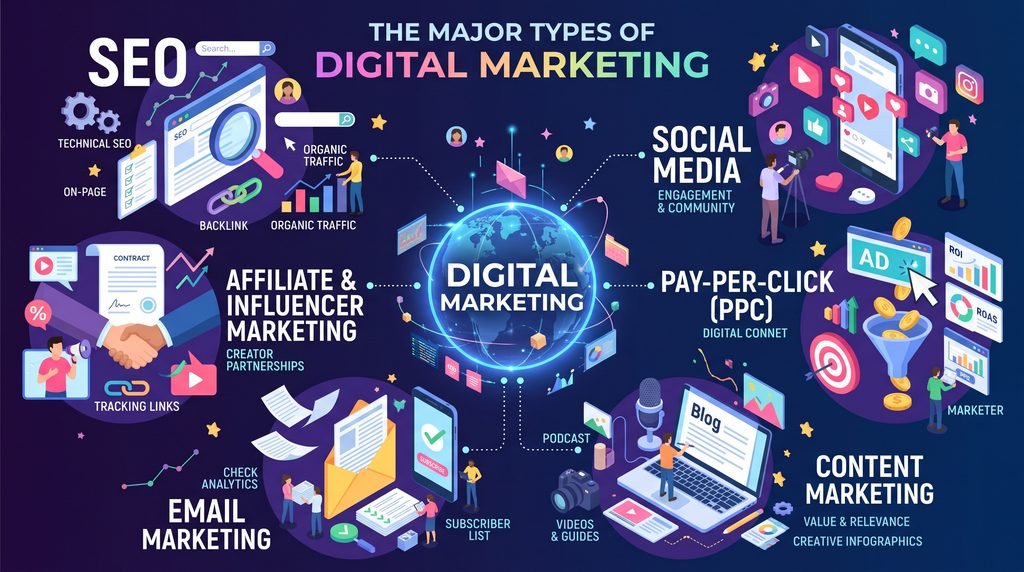
Digital marketing involves various approaches, each of which serves different purposes. What a business needs and can afford, depends on its goals, target audience, resources, and budget.
Let’s discuss the major types of digital marketing.
1. Search Engine Optimization (SEO)
Search engine optimization, or SEO, is about optimizing a website to show up higher in relevant organic search results.
People use search engines to find the information and the products they want. So, by using Search engine optimization SEO, businesses can reach those who are interested in what they offer.
There are three areas of SEO:
On-page SEO: It includes optimization of page titles, headings, text content, links, and images to make a website understandable for both search engines and visitors.
Off-page SEO: This type of SEO focuses on building a reputation of a website thanks to relevant backlinks and other external references.
Technical SEO: It means improving website crawling and indexing, mobile usability, architecture, and performance.
Another important component of SEO is keyword research. It helps digital marketers learn more about what audience is looking for and what topics deserve their attention.
However, just repeating keywords won’t bring good results. Instead, create valuable content that answers people’s questions
Search Engine Optimization often requires persistence and patience. Even though it may take some time, the properly optimized website can generate relevant traffic in the long run.
2. Social Media Marketing
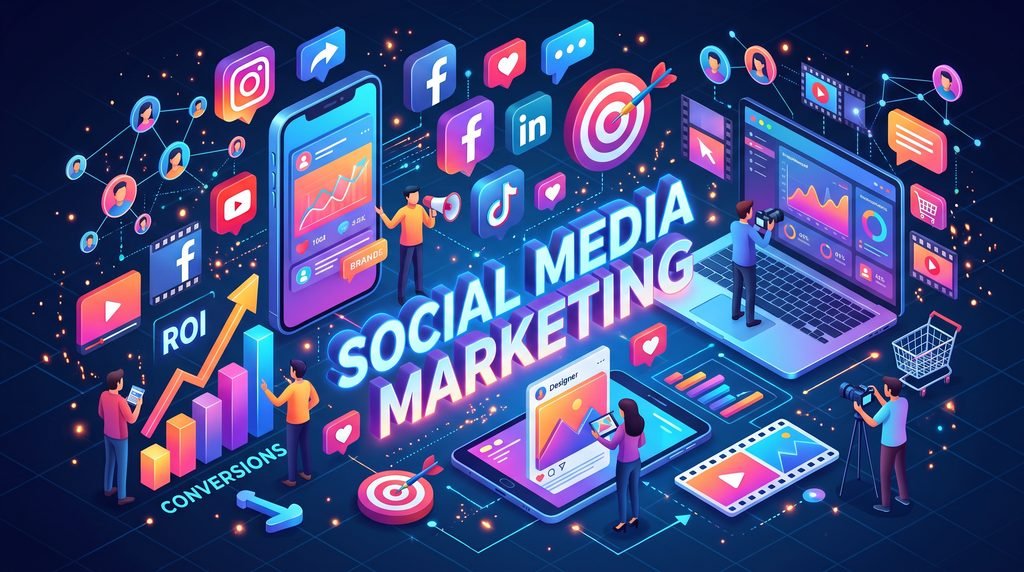
Social Media Marketing includes promoting a business, distributing content, and engaging audiences via Facebook, Instagram, LinkedIn, TikTok, and YouTube.
The businesses can use social media to show off their products and services, provide education to the audience, answer questions and develop communities of loyal fans.
Firstly, you need to define your target audience and find out the platforms where they are active. For instance, LinkedIn may be useful for a professional services company, while Instagram and TikTok are good for the fashion brand that uses visual content.
It is crucial to be consistent. Provide relevant information and be responsive to the comments and messages of the people following your page.
Among popular types of the content are short videos, educative carousels, infographics, demonstration videos of the products and services, behind the scenes content, and testimonials from satisfied customers.
Nevertheless, having many followers does not necessarily mean success. Rather, focus on the following metrics: engagement rate, visits to the website, qualified leads, and sales.
3. Pay-Per-Click Advertising (PPC):
The pay-per-click (PPC) advertising is an online advertising business where an advertiser usually pays when a person clicks his ad. One of the examples of PPC advertising is Google Ads. This service allows a business to show his ads to people who are interested in buying their product or using their service. Besides, many social media platforms have a number of ways of targeting particular audiences.
PPC can generate traffic rather quickly comparing with other online marketing methods. That is why it is useful in case of launching new products, seasonal offers, lead generation, and so on.
However, for a successful PPC campaign, the business should develop certain strategy. Namely, it should have relevant keywords or audience targeting, interesting ads and useful landing page. It is also necessary to monitor a number of important metrics such as cost per click, conversion rate, cost per acquisition, and return on ad spend. In addition to measuring clicks, the business should also monitor valuable actions like purchasing, inquiry and registration.
4. Content Marketing:
Content marketing means the creation and publication of informative materials with the purpose of attracting and engaging target audiences.
Businesses do not use only promotion but supply customers with valuable content which can help in answering various questions or make decisions related to purchasing some products or services.
Popular content includes blog posts, videos, podcasts, guides, case studies, newsletters, infographics, etc.
For instance, the digital marketing agency may create a blog post about how small businesses can boost their social media performance. After reading the useful article, subscribers will be able to get familiar with services offered by the agency.
Content marketing can be useful for SEO, boosting brand recognition, increasing credibility, helping customers with making the right choice before making a purchase. To achieve those results, businesses should create content according to the needs of their audiences and provide customers with reliable information which is easy to comprehend.
Also, there should be a call to action included in each piece of content.

5. Email Marketing:
Through email marketing, companies reach out to people who have willingly signed up to receive messages from them.
Newsletters, promotions, educational material, order updates, and follow-up emails can be sent to potential and actual customers.
One good thing about email marketing is that companies are able to customize messages based on various subscriber categories. For instance, a new subscriber can receive a welcome message containing valuable material. On the other hand, existing customers could get information regarding new products.
For effective email marketing, some guidelines include the following:
- Writing clear and compelling headlines.
- Offering useful information in all emails.
- Creating mobile-friendly emails.
- Having a call to action.
- Adhering to subscriber consents and unsubscribe requests.
In addition, it is advisable to analyze clicks, conversions, and other pertinent performance metrics.
6. Affiliate Marketing:
Affiliate marketing is a partnership where individuals or organizations promote products or services of another business organization in return for some sort of benefit agreed on.
The benefit may be financial and may be in form of commissions for the number of sales made by the person who promoted it through a tracked link. This type of marketing enables companies to partner with individuals who are able to introduce their products to a particular audience.
The success of the affiliate marketing depends on having appropriate partners, expectations, proper tracking and disclosure of promotion partnerships.
7. Influencer Marketing:
Influencer marketing is a type of marketing that involves the partnering of a company with a content creator whose audience is well known in the social media space.
Such a content creator is able to introduce the brand to the people who read his or her content. For instance, a fitness brand can partner with the fitness creator who is able to present its products and describe them to its followers.
However, the selection of an influencer should not only depend on the number of followers. The quality of interaction between the content and followers should also be considered.
How to Create an Effective Digital Marketing Strategy
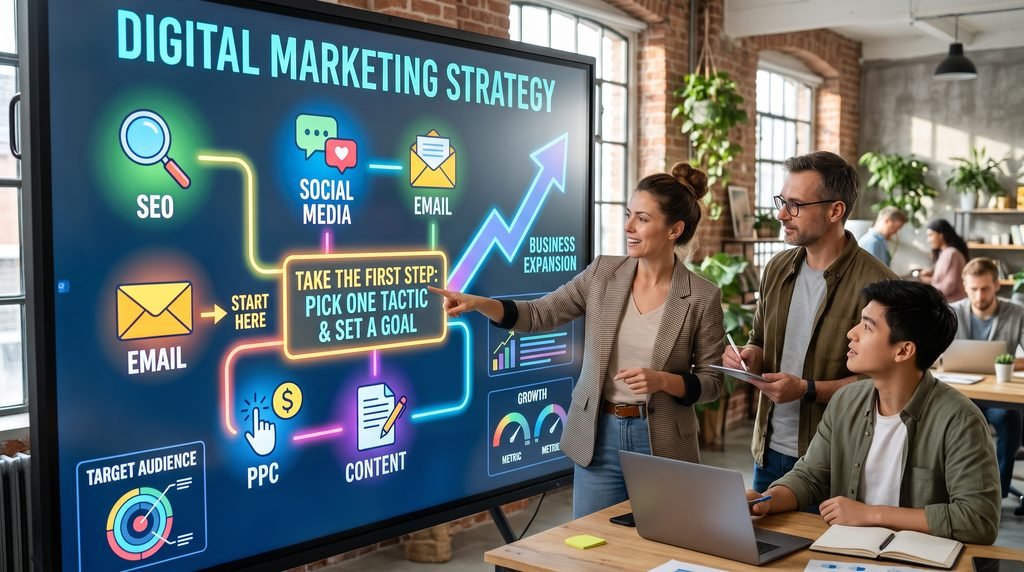
A well-thought-out marketing strategy helps your company navigate its efforts in a certain direction. Otherwise, any marketing-related activities may prove to be time-consuming and costly.
Here are six steps you need to follow when crafting a digital marketing strategy aligned with your business goals.
Step 1: Define Marketing Goals
The first step is to decide on what you want to accomplish. The goals may encompass raising brand awareness, attracting traffic to your website, lead generation, improving sales, or customer retention.
Set a particular target to measure your success. For instance, it may relate to growing your list of qualified website inquiries by 15% during the next three months.
Having an explicit target helps you track the success of your campaigns.
Step 2: Analyze Your Target Audience
The next step is to analyze your prospective customers. Take into account the needs, preferences, problems, behavior, and buying motives of your customers.
There are different ways to get the relevant information including interviews and surveys, data gathered from website analytics, and information shared by the target audience on social networks.
This information will allow you to craft more targeted messages and offers.
Step 3: Choose Relevant Marketing Channels
Not all marketing channels are right for all businesses. Thus, choose channels depending on the target audience, marketing goals, budget, and other available resources.
Thus, local SEO and Google Ads may work well for a local service provider. However, an online clothing store may need visual social media marketing, ads, and email marketing.
Choose a few channels to start with. Next, refine the campaigns before moving on to new platforms.
Step 4: Create Valuable Content
Your content should answer questions, describe services, and deal with potential issues of interest to the customers.
First, plan everything with the help of a content calendar. It should contain information about the publishing dates, types of content, formats, etc.
In addition, make sure that there is consistency in terms of the brand’s voice and visual identity.
Step 5: Optimize Your Website
Your website needs to play its part in your digital marketing campaign, by providing relevant information about the services offered by your company and offering users ways to interact.
Make sure that your website works on all devices and loads quickly, while being intuitive to use. Provide descriptions of services you offer, contact information, and actions users should perform.
For instance, people visiting your website should be able to contact your company, order a price quote, or learn more about the services you provide.
Step 6: Analyze and Enhance Your Campaign Results
In conclusion, use the power of analytics tools to assess how well your campaign worked, where your visitors came from, what content was most popular and how much value was gained through which channels.
Regularly review the performance of your campaigns, and then use the data gathered to improve your targeting and budgeting, as well as your landing pages and content.
The Future of Digital Marketing
Future of Digital Marketing
With the development of technology and evolving customer needs, digital marketing will continue to develop. It is important to adhere to promising tendencies but keep in mind the target audience.
AI in Marketing
AI is used to develop ideas, analyze data, automate tasks, and deliver personalized customer experiences. Nevertheless, human review is needed to make sure that information is accurate, good, and in line with brand standards.
Short-Form Video Content
Short-form videos can be used to introduce your products, give tips, and showcase your brand using how-to videos, demo videos, and behind-the-scenes content.
Personalized Customer Experience
It is possible to send targeted content and recommendations about the offers based on customers’ preferences and choices.
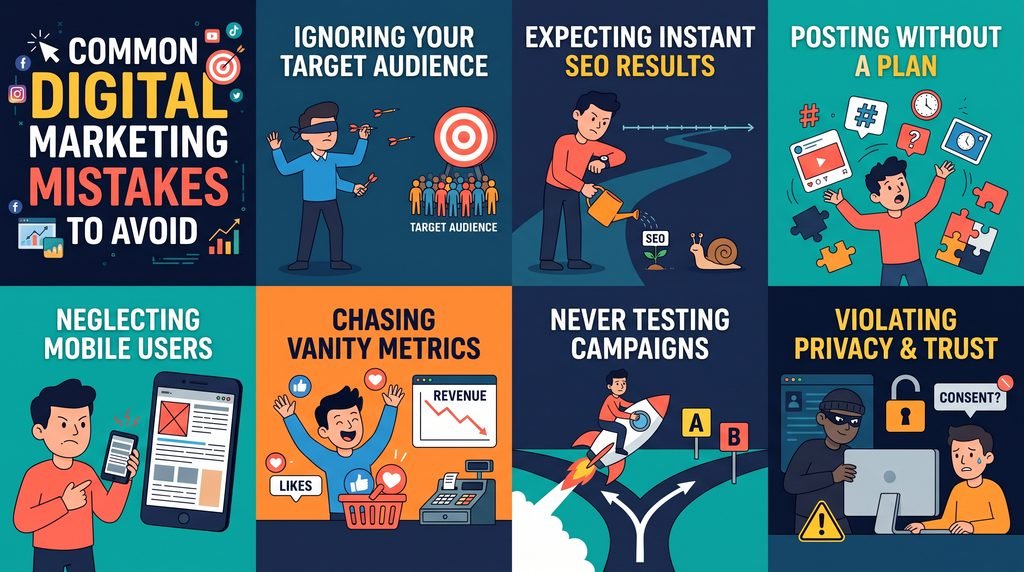
Privacy and Customer Trust
Proper usage of customers’ data, privacy policies, and permission-based correspondence are helpful in building good relationships.
All in all, technology, creative solutions, and proper usage of data help businesses adapt to changes in digital marketing.
Frequently Asked Questions About Digital Marketing
What is digital marketing?
Digital marketing is the promotion of products and services using online channels, such as search engines, social media, websites, email, and online advertisements.
Why do small businesses need digital marketing?
It allows small businesses to connect with customers, increase brand awareness, and promote their services along with measuring the performance of their marketing campaigns.
What is the right digital marketing technique for a business?
First, set the objectives and know your target market before selecting the right channel like SEO, social media, or paid advertising.
How long does it take to get digital marketing results?
Paid advertisements start getting results instantly, but SEO may take time. The results vary based on the method you use, the competition, your budget, and persistence.
How can success be measured in digital marketing?
Keep a track of website traffic, engagement, lead generation, conversion rates, sales, and advertising expenditure.

Conclusion: Expand Your Business Through Digital Marketing
Digital marketing provides businesses with effective tools for establishing connections with customers, increasing brand awareness, and promoting growth. With the help of online channels, companies can market themselves and track the results of their marketing efforts.
The list of available opportunities is rather diverse and includes SEO, social media marketing, PPC ads, content marketing, email marketing, affiliate marketing, and influencer marketing. The choice of channels depends on your business objectives, target audience, budget, and other factors.
First of all, determine your objectives, identify your target audience, select channels appropriate for marketing your services, and produce high-quality content. You should also evaluate your progress in order to make adjustments where needed.
No matter whether you own a small business, work as a freelancer or manage a developing company, you can use digital marketing to develop relations with your customers.
Do you want to expand your business online? Check out Elevara Marketing for more information about digital marketing tools and services that will help you to achieve your objectives.
Start with one marketing channel, set your objective, and keep moving forward step-by-step.

Adnan
October 24, 2026Digital marketing is essential for building a strong online presence and growing a successful business. From SEO and social media marketing to paid advertising and content creation, the right strategy can help businesses reach their target audience, build trust, and achieve long-term growth. This guide is a great starting point for anyone looking to grow their business online.
admin
October 24, 2026Thank you for your valuable feedback! Glad you found this guide helpful. Stay connected for more digital marketing tips and strategies!
Aleena Nasir
October 24, 2026Great insights on lead generation! A helpful read for businesses looking to grow their online presence and attract potential customers.
admin
October 24, 2026Thank you for your kind words! Glad you found it helpful. Stay tuned for more insights!